
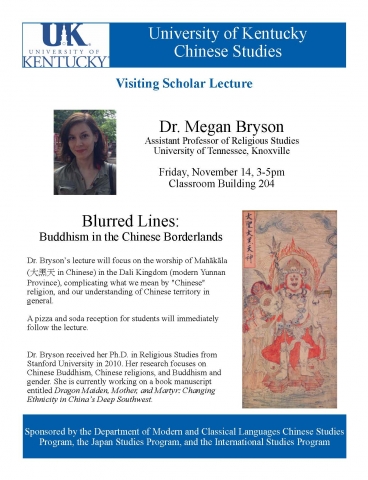
Blurred Lines: Buddhism in the Chinese Borderlands
Date:
-
Location:
White Hall (Classroom Building) Room 204
Event Series:
The Department of Modern & Classical Languages, Literatures, & Cultures is excited to welcome Assistant Professor Brenna Byrd to its faculty! This podcast is part of a series highlighting the new faculty members who joined the College of Arts and Sciences in the fall 2014 semester.
This podcast was produced by Casey Hibbard.
While in verb-initial Old Irish, topicalization was achieved via left dislocation and focalization was achieved through clefting, the older Continental Celtic languages achieved such pragmatic information structuring through movement into the left periphery of the clause (though the right edge of the clause could also be a target for such purpose). This paper commences with an inspection of relative clause syntax in Continental Celtic while outlining what we can tell about other movement mechanisms in the clause and then goes on to explore the architecture of the left periphery in these languages. This exploration provides some insight into the prehistoric development of verb-initial clausal configuration in Insular Celtic. Some comparative attention is also paid to the architecture of the left periphery in other Indo-European languages and it is found that the Continental Celtic languages have a role to play in determining the degree of articulation to be reconstructed for the left periphery of proto-Indo-European itself.
The Department of Modern and Classical Languages, Literatures, and Cultures is excited to welcome Associate Professor Molly Thomasy Blasing to its faculty!
This podcast is part of a series highlighting the new faculty members who joined the College of Arts and Sciences in the fall 2014 semester.
This podcast was produced by Casey Hibbard.
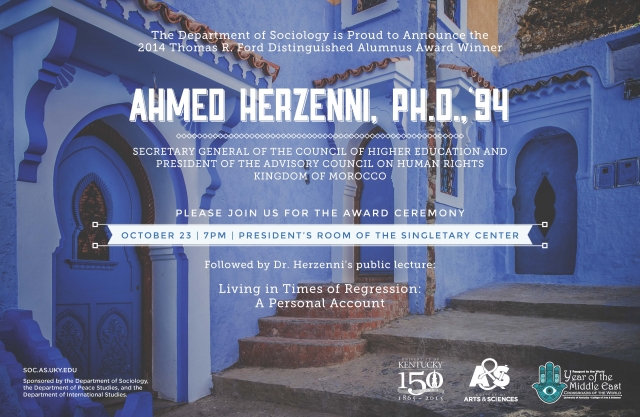
Joe Goodkin's Odyssey is a 30-minute original musical composition for solo acoustic guitar and voice, a folk opera that tells the story of Homer's Odyssey in a series of 24 short songs.
The Department of Modern and Classical Languages, Literatures, and Cultures excited to welcome Assistant Professor Julie Human to its faculty!
This podcast is part of a series highlighting the new faculty members who joined the College of Arts and Sciences in the fall 2014 semester.
This podcast was produced by Casey Hibbard.
The Department of Modern and Classical Languages, Literatures, and Cultures is excited to welcome Assistant Professor Ioana Larco to its faculty!
This podcast is part of a series highlighting the new faculty members who joined the College of Arts and Sciences in the fall 2014 semester.
This podcast was produced by Casey Hibbard.
The second in the “Works in Progress Series” features Melissa Adler, Assistant Professor in the School of Library and Information Science. She will be discussing the introduction to her book manuscript, tentatively titled Perverse Subjects: Becoming Bodies of Literature in the Library. The book provides an account of the ways in which the Library Congress classification standards that organize research libraries in the U.S. and abroad have reproduced normative ideas about sexuality since the beginning of the 20th century. The project challenges these classifications through the lens of perversion, echoing Eve Kosofsky Sedgwick’s call to become “perverse readers.”
Carol Mason (GWS) and Rusty Barrett (Linguistics) will serve as respondents. Attendees should email CST Director Dr. Marion Rust (marion.rust@uky.edu) for a copy of Dr. Adler’s paper.